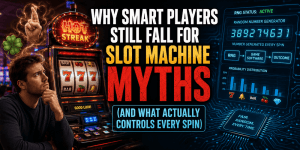
Why Smart Players Still Fall for Slot Machine Myths (And What Actually Controls Every Spin)
Slot machine myths convince smart, educated players every single day, and intelligence has nothing to do with it. At Reels of Joy, we notice the same patterns each session: players hunting for a “loose” machine, timing spins around imagined hot streaks, or trusting a lucky ritual that has never once changed a result.
Gambling superstitions survive because they satisfy a deep psychological need for control, not because they hold any statistical truth. Casino myths, slot superstitions, and gambler’s fallacy thinking all trace back to how the brain processes randomness and near wins. This piece breaks down the psychology behind popular slot machine myths, and what actually decides every spin.
Slot Machine Myths Persist Because the Brain Rewards Pattern Recognition, Not Because Machines Behave Differently
The human brain evolved to spot patterns. Recognising a rustle in the grass as a predator, or a change in weather as a warning sign, kept early humans alive. That same wiring now searches for patterns in places where none exist, including the spinning reels of a slot game.
Psychologists call this apophenia: the tendency to perceive meaningful connections between unrelated events. A player who wins twice after tapping the screen a certain way links the tap to the win, even though the two events share no causal relationship. The brain does not distinguish between a genuine pattern and a coincidence dressed up as one.
Slot machine myths grow directly out of this wiring. A player does not choose to believe a machine is “due” for a jackpot. The belief forms automatically, below conscious reasoning, because the brain treats a losing streak as data that predicts the next outcome. Most slot machine myths follow this exact template: a random event gets reinterpreted as a meaningful signal.
The “Due for a Win” Myth Comes From the Gambler’s Fallacy, Not From How Random Number Generators Work
Every licensed online slot runs on a Random Number Generator (RNG), a certified algorithm that produces thousands of number sequences per second, even when nobody is playing. The moment a player presses spin, the RNG locks in whichever sequence lands at that exact instant. That sequence has no connection to the spin before it or the spin after it.
This is where the gambler’s fallacy takes hold. The fallacy is the false belief that past outcomes influence future ones in an independent, random system. A coin that lands on heads five times in a row is not “due” for tails. The sixth flip still carries exactly 50/50 odds, because the coin has no memory. A slot reel works the same way, and the table below sets out the most common slot machine myths against what actually happens inside the software.
| What Players Believe | What Actually Happens |
| A machine that hasn’t paid in hours is “due” for a win | Each spin is generated independently; no spin is ever owed a result |
| Betting bigger after a losing streak improves the odds | Bet size changes the payout amount, not the probability of winning |
| A machine “remembers” recent spins | RNGs have no memory function; results are not sequential or stored |
| Certain times of day pay better | Payout percentages are set in the game’s programming, not the clock |
Independent testing labs audit RNG software before it goes live, confirming that outcomes are not predictable, patterned, or influenced by prior spins. That certification is what separates a regulated slot game from folklore about “loose” machines in the corner of a casino floor, and it is the clearest evidence against this particular slot machine myth.
Hot and Cold Slot Machine Myths Ignore How RNGs Reset With Every Single Spin
The idea of a “hot” machine on a winning run, or a “cold” one locked into a losing spell, feels intuitive because streaks genuinely happen in random systems. Random does not mean evenly spread. A fair coin can land on heads seven times in a row purely by chance, and a slot game can pay out three times in five spins for the same reason.
The mistake is assuming a streak predicts what comes next. It does not. Because the RNG resets fully with every spin, a run of wins carries zero information about the following spin. Treating a “hot” machine as more likely to pay again, or switching away from a “cold” one expecting it to turn, applies logic borrowed from skill-based activities to a system built entirely on independent probability.
Lucky Rituals and Charms Persist Because of the Illusion of Control Behind These Slot Machine Myths
Wearing a certain shirt, tapping the spin button twice, or carrying a coin for luck are common rituals among players, and none of them influence a single outcome. Psychologist Ellen Langer named this effect the illusion of control: the tendency to believe personal actions affect outcomes that are, in fact, entirely random.
The illusion of control forms because gambling combines two features the brain struggles to separate: active participation (choosing when to press spin) and a random result. Because the player takes an action immediately before the outcome, the brain links the action to the result, even in games where skill plays no role at all.
Rituals persist because they reduce anxiety, not because they change probability. A player who performs the same routine before every session may feel calmer and more focused, which can make the experience more enjoyable. That comfort is real. The influence on the reels is not.
Near Misses Trick the Brain Into Treating Almost-Wins as Meaningful Signals
Among all the slot machine myths covered here, the near-miss effect is the hardest one to out-think, because it works on a reward-system level rather than a logical one.
A near miss happens when the reels stop one symbol away from a jackpot line. Neuroscience research on reward processing shows that a near miss activates similar brain regions to an actual win, even though the outcome is a loss. This is one of the most well documented mechanisms behind slot machine myths and their pull on regular players, and it explains why the near-miss myth is so hard to shake even once a player understands the RNG.
The brain interprets a near miss as evidence that a win is close, prompting another spin in pursuit of it. In reality, a near miss carries no more predictive value than any other losing spin. The reels stopping one position away from a jackpot symbol is not a signal. It is a losing outcome that happens to look encouraging.
Game designers are aware of this effect, and licensed slot software cannot be tuned to manufacture near misses at a rate higher than genuine RNG probability without failing the fairness testing required for certification. Reels of Joy’s random number generator determines every game outcome, as set out in our terms and conditions, so the frequency of near misses reflects real, unmanipulated odds rather than a deliberately engineered psychological trigger.
Intelligence Does Not Protect Against Slot Machine Myths Because Superstition Operates Below Rational Thought
Psychologist Daniel Kahneman, awarded the Nobel Memorial Prize in Economic Sciences in 2002 for his research on judgment and decision-making under uncertainty, later described two systems of thinking in his work: a fast, automatic, emotional system, and a slower, deliberate, analytical one. Slot machine myths take root in the fast system. A university-educated player can explain, in detail, how an RNG functions, and still feel a jolt of confidence after tapping the screen a certain way before a win.
This is not a failure of intelligence. It is a feature of how belief and instinct form separately from logical reasoning. Gambling superstitions and slot machine myths bypass the analytical system entirely, forming through repetition, emotional reward, and pattern-seeking instincts that operate outside conscious control.
Recognising this gap matters more than memorising RNG mechanics. A player aware that superstition operates automatically can notice the belief forming (“this machine feels lucky”) without acting on it as if it were fact.
Recognising Slot Machine Myths Changes How Players Approach Every Session
Understanding the psychology behind these slot machine myths does not remove the fun from playing. It changes the relationship a player has with the game. The psychology of gambling beliefs shows why a player who knows a losing streak is not “due” to end is less likely to increase bets in pursuit of a correction that random systems do not owe anyone.
Practical takeaways from the psychology of slot machine myths, drawn from the mechanisms explained above:
- Every spin stands alone. No streak, ritual, or timing choice changes the RNG outcome.
- Near misses are losses. Treat them as such, not as a sign to keep chasing a result.
- Bet size affects payout value, not win probability.
- Session limits and time limits work better than superstition at managing outcomes, because they are based on numbers a player actually controls.
Our support team can walk players through account tools such as deposit limits and session reminders, which manage real, adjustable variables rather than imagined lucky patterns.
Responsible Gambling
Reels of Joy is restricted to players aged 18 and over, or the legal age of majority in their jurisdiction, whichever is higher. Gambling carries financial risk, and no myth, ritual, or strategy changes the underlying odds of any slot game. Play should stay entertainment first, within a budget a player can afford to lose, and never as a way to recover previous losses.
Players who feel their gambling habits are becoming difficult to control can reach independent, internationally recognised support organisations:
- BeGambleAware (begambleaware.org)
- GamCare (gamcare.org.uk)
- Gamblers Anonymous (gamblersanonymous.org)
- Gambling Help Online, for players in Australia (gamblinghelponline.org.au)
These organisations operate independently of Reels of Joy and offer confidential advice, helplines, and self-exclusion guidance to anyone affected by gambling harm.