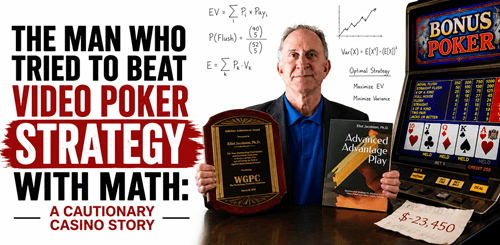
The Man Who Tried to Beat Video Poker Strategy with Math: A Cautionary Casino Story
Video poker strategy convinces a lot of players that skill can flip the house edge in their favour, and one real story shows exactly how far that idea can be pushed before the math pushes back. This video poker strategy breakdown looks at two very different men who treated video poker as a numbers problem: Eliot Jacobson, a Santa Barbara mathematician who studied casino games until he understood their weak points, and Stephen Paddock, a Las Vegas gambler whose video poker habits made headlines for reasons that had nothing to do with cards.
At Reels of Joy, we break down what happened, what the numbers actually prove, and what any Australian player chasing a video poker edge needs to understand before betting a single hand.

Video Poker Strategy Lowers the House Edge, It Does Not Remove It
A correct video poker optimal strategy chart brings the house edge on a full-pay 9/6 Jacks or Better machine down to 0.46%. Full-pay Deuces Wild goes further still, tipping the return to 100.76% for a player who never deviates from the optimal hold pattern. Those figures come from published payout tables and hold up under independent verification. You can check the math on any of our strategy tables, and you can play them yourself through our video poker games.
None of that math promises a winning session. Expected value is a long-run average, not a guarantee for the next hand, the next hour, or the next year. A player following perfect video poker math strategy can still lose for months in a row and come out ahead only because thousands of hours of play eventually pull results toward the theoretical return. That gap between theory and short-term reality is exactly where this story starts.
The Santa Barbara Mathematician Who Turned Video Poker Math into a Career
Eliot Jacobson spent years applying mathematical analysis to casino games rather than blackjack card counting, which is where most gambling math stories usually begin. He built simulations, tested paytables, and found weaknesses in games that casinos assumed were airtight.
His work went beyond video poker alone. Jacobson studied shuffle procedures, side bets, and proprietary table games, eventually earning bans from multiple casinos for spotting edges the house never expected a player to find. Casino security teams rarely ban players who are losing money. They ban players who consistently win, and Jacobson won often enough to draw that kind of attention.
What separates Jacobson’s story from the cautionary side of this article is discipline. He treated every game as a math problem first and a gambling session second. He tracked results, understood variance, and walked away from games once the edge disappeared. That approach is the version of advantage play video poker players actually need to succeed over time, and it looks nothing like chasing losses or gambling on instinct.
Stephen Paddock Applied Real Video Poker Strategy for Over Twenty Years
Stephen Paddock was, according to multiple gambling analysts who reviewed his play, a legitimate high-level video poker player long before his name became connected to the deadliest mass shooting in modern American history in October 2017. That tragedy sits entirely outside the scope of gambling strategy, and it carries no lesson about math or odds. What his gambling records reveal, separately from that event, is a detailed case study in what disciplined video poker play looks like when it is pushed to an extreme scale.
Early reporting on Paddock’s 2015 play placed him at the $25 denomination on 8/5 Bonus Poker machines, betting five coins per hand for a $125 wager and a return close to 99.17% with correct play. FBI records released years later and reported by CBS News show his stakes grew over time: during a two-day stay at the Tropicana Las Vegas in September 2017, he lost $38,000, and one FBI document noted his preferred bet size had climbed to $200 or more per hand. Speed estimates from people who watched him play put his hand count near a thousand per hour, fast enough to push six figures through a single machine in one sitting.
His brother, Eric Paddock, told CBS and NPR that Stephen gambled successfully for over twenty years and treated it “like a job.” Casino comps followed the volume of his play: free hotel suites, meals, and show tickets, the standard reward structure high-limit video poker players receive. Casinos calculate those rewards from a player’s theoretical loss, a figure based on bet size and hours played, and that figure sits separate from whatever a player actually wins or loses on any single trip.
The Numbers Behind Paddock’s Video Poker Play Show Why the Edge Always Wins Eventually
Financial analysts who reviewed public reporting on Paddock’s 2015 gambling activity estimated his win reporting for tax purposes (triggered automatically at $1,200 per hand on video poker) totalled around $5 million that year. Working backward from that figure using the known 99.17% return on his preferred machine, analysts at the Nevada Independent calculated his realistic net loss for the year at roughly $404,933, offset partly by comps.
That gap between headline winnings and real financial outcome is the entire lesson every serious video poker player needs to learn:
| What Gets Reported | What It Actually Means |
| $5 million in W-2G tax forms | Total value of hands that hit a $1,200+ payout threshold, not net profit |
| 99.17% RTP on his chosen machine | Expected loss of roughly $1.04 per $125 hand over time |
| Estimated 388,000+ hands played in a year | Enough volume for the house edge to apply with statistical certainty |
| Roughly $404,933 estimated net loss | The real financial result once every hand is averaged out |
| $38,000 lost in a single two-day stay (2017) | Confirms losses continued even at his advanced skill level |
FBI records also show Paddock carried a gambling bankroll of two to three million dollars, and a gambler who spoke to investigators said Paddock was frustrated with how casinos treated high rollers like him. None of that frustration changes the math. A player who wagers millions of dollars a year on a machine with a fixed return under 100% will lose money over time, no matter how sharp the strategy or how large the bankroll behind it.
Where the “Beat Video Poker with Math” Idea Breaks Down for Everyday Players
A correct video poker strategy genuinely reduces the house edge to a fraction of a percent on the best paytables. It does not eliminate that edge on the vast majority of machines, and it never turns a losing session into a guaranteed win. Three misunderstandings show up again and again among players who hear stories like this one:
1. Skill and volume are not the same as profit. Playing thousands of hands with textbook-perfect strategy still produces losses across any stretch of bad variance. Long-run math only shows up over genuinely long runs.
2. Comps are not free money. A comped room or meal is a percentage of the casino’s calculated theoretical win from a player’s action. It offsets losses; it does not cancel them.
3. Full-pay machines are rare outside careful selection. Paytables vary between 6/5, 8/5, and 9/6 versions of the same game, and the difference between them can shift the house edge by several percentage points. Reading the paytable before betting is the single habit that separates informed players from everyone else feeding the machine on hope.
Applying Real Video Poker Strategy in Australia Means Starting with the Paytable
Australian players who want a video poker probability system that actually holds up start in the same place Jacobson did: with the numbers, not the legend. Check the paytable on any machine before committing real money. A 9/6 Jacks or Better game returns 99.54% with correct play. A 6/5 short-pay version of the same game can drop that return to 95% or lower, a gap that costs a player real money over a long session regardless of how sharp their hold decisions are.
Bankroll management matters as much as the strategy chart itself. Set a session budget before you sit down, track wins and losses honestly, and treat any bonus terms tied to video poker play as part of your calculation rather than an afterthought. At Reels of Joy, video poker contributes 10% toward clearing wagering requirements on our welcome bonuses, and bets during active bonus play are capped at $10 per hand. Knowing those numbers before you start protects your bankroll and your bonus funds at the same time.
Responsible Gambling Comes Before Any Video Poker Strategy
Every story about a player chasing an edge with math carries the same underlying warning: gambling always carries financial risk, and no amount of strategy changes that fact for good. Video poker, even at its best paytables, is entertainment with a built-in cost over time, not a reliable source of income.
You must be 18 years or older to register and play at Reels of Joy. If gambling stops feeling like entertainment, or if you notice yourself chasing losses, extending sessions past your budget, or hiding the extent of your play from people close to you, reach out for support before those patterns grow.
Support is available through:
• Gambling Help Online: 1800 858 858 (Australia)
• BeGambleAware: begambleaware.org
• GamCare: gamcare.org.uk
• Gamblers Anonymous: gamblersanonymous.org
• Gambling Therapy: gamblingtherapy.org
• Lifeline Australia: 13 11 14
Review the full set of account tools, deposit limits, and self-exclusion options on our responsible gambling page.